Automation vs AI Agents: What the Data Says in 2026
Workflows or AI agents? Verified 2025 and 2026 data on agent adoption, reliability and cost, plus the 5 levels of AI in GTM and when each one wins.

By Daniel Matias, Founder, Deep Loom
· 8 min read
Short answer
Use automation, a workflow with fixed steps, for anything that runs the same way every time. Use an AI agent only for the steps that need judgment, and put an approval in front of anything that goes out. The data backs this: Gartner expects over 40% of agentic AI projects to be cancelled by the end of 2027, and a 2026 study of agents in production found 68% run at most 10 steps before a human steps in. Our own GTM stack runs 24 agents behind one approval queue, yet the model is only 2 of the 20 tools it runs on.
Key takeaways
- A workflow follows a path you wrote. An agent chooses its own path. Anthropic and OpenAI both advise starting with the simplest option that works.
- Agents are capable but not yet reliable: on software tasks, frontier models finish roughly 12-hour tasks half the time, but only about 1.5-hour tasks 80% of the time.
- Most production agents are short and supervised. In one 2026 study, 16 of 20 case studies used structured workflows rather than open-ended planning.
- 'Automation is dead' keeps being wrong. n8n, a workflow tool, went from a $2.5B to a $5.2B valuation in seven months.
- Put agents only where thinking is needed, behind an approval step, inside a workflow you can debug.
What is the difference between automation and an AI agent?
“Workflows are systems where LLMs and tools are orchestrated through predefined code paths. Agents, on the other hand, are systems where LLMs dynamically direct their own processes and tool usage.”
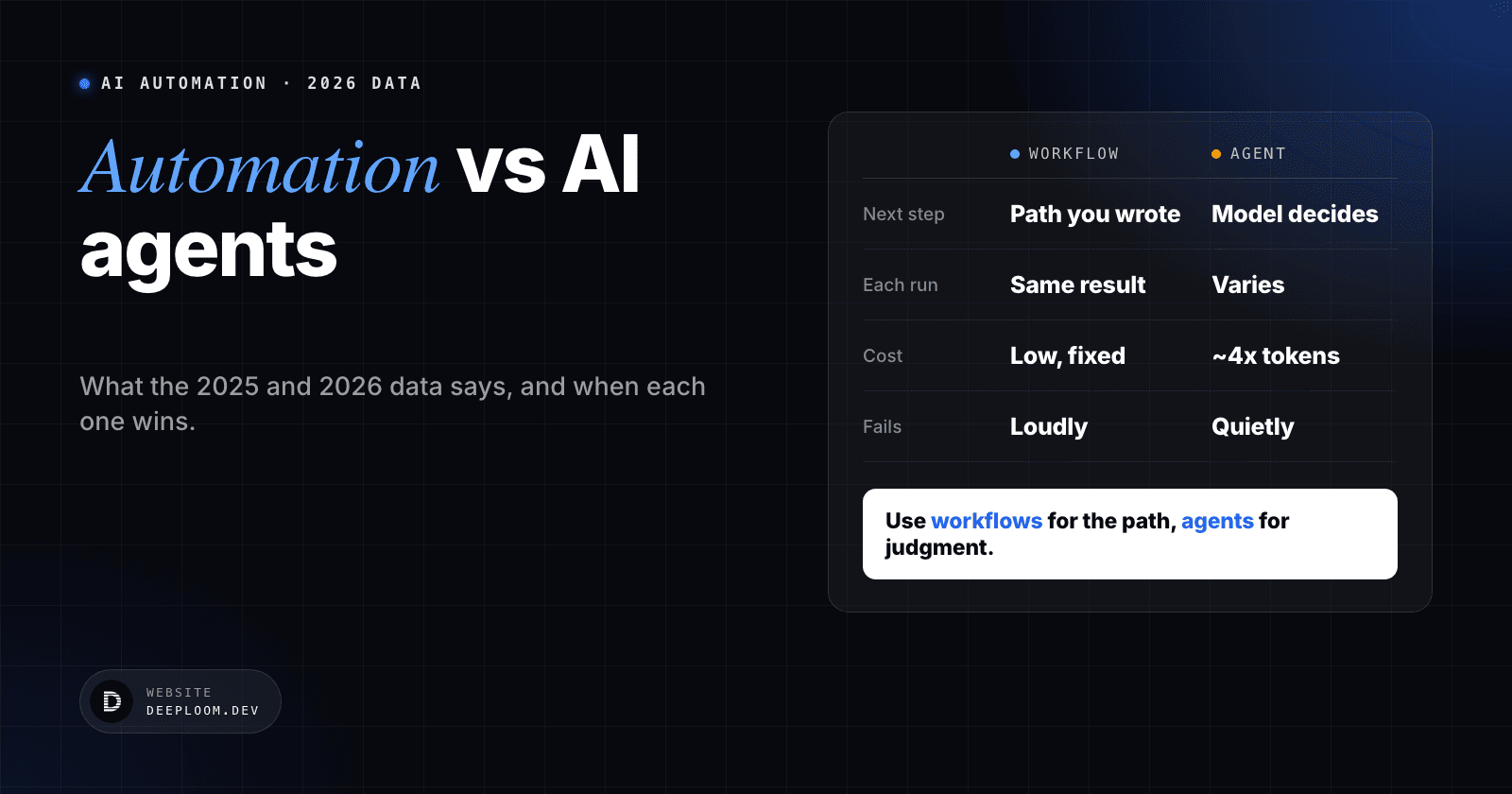
In plain terms: in a workflow, you decide the steps. In an agent, the model decides them. OpenAI's guide to building agents draws the same line, and adds that for many problems 'a deterministic solution may suffice'.
| Automation (workflow) | AI agent | |
|---|---|---|
| Who decides the next step | The path you wrote | The model, at run time |
| Predictability | Same input, same result | Varies from run to run |
| Cost per run | Low and fixed | Higher: agents use about 4x the tokens of a chat, multi-agent systems about 15x |
| How it fails | Loudly, at a known step | Quietly, with a confident answer |
| Best for | Routing, syncing, sending, booking | Research, judgment, messy inputs |
What does the data say about AI agents in 2026?
Adoption is real, but production is rarer than the headlines suggest:
Gartner calls the gap agent washing: chatbots and assistants rebranded as agents without real agentic capabilities. Deloitte's 2026 survey of 3,235 leaders found close to three quarters plan to deploy agentic AI within two years, but only 21% have a mature model for governing agents. And MIT traced most failed projects to 'brittle workflows' and a 'lack of contextual learning'.
Are AI agents reliable enough to run on their own?
Not for long, unsupervised jobs yet. Capability and reliability are two different numbers:
| Measure | Result | Source |
|---|---|---|
| Software task length frontier models finish 50% of the time | About 12 hours | METR, May 2026 |
| Software task length they finish 80% of the time | About 1.5 hours | METR, May 2026 |
| Office tasks completed autonomously by the best agent | 30% | TheAgentCompany |
| CRM tasks, single turn vs multi-turn | About 58%, falling to about 35% | Salesforce CRMArena-Pro |
| Agents that run at most 10 steps before a human steps in | 68% | Measuring Agents in Production, 2026 |
Errors also compound. As a simple illustration: if each step is right 95% of the time, a 10-step chain gets everything right only about 60% of the time. Anthropic warns of exactly this: 'higher costs, and the potential for compounding errors'.
Is automation dead?
It has been declared dead about every few years since the 2000s, and every time demand went up:
| Year | Why it was 'dead' |
|---|---|
| 2000s | Cheap offshore labour makes it pointless |
| 2012 | Zapier is just toys |
| 2016 | RPA is a fad |
| 2018 | RPA bots keep breaking |
| 2019 | No-code replaces builders |
| 2023 | ChatGPT replaces automation |
| 2024 | Agents replace workflows |
| 2025 | Claude Code replaces n8n |
The numbers say otherwise. UiPath grew revenue 13% to $1.61 billion in its 2026 fiscal year. n8n raised at a $2.5 billion valuation in October 2025, with revenue up tenfold and more than 3,000 enterprise clients, and reached $5.2 billion seven months later. Forecasts for the workflow automation market range widely by definition, but one puts it at $25.1 billion in 2025, growing to $65.3 billion by 2034.
Each 'death' killed one version of automation: the brittle one. The RPA bot that broke when a button moved. The no-code flow nobody could debug. The agent handed a whole job with no guardrails. What survives is the version where every tool has one job, and the agent only thinks where thinking is needed.
'Automation is dead': declared eight times, still growing.
What are the 5 levels of AI in go-to-market?
The same six steps run every outbound pipeline: find, research, write, send, reply and book. What changes from level to level is who does them.
| Level | Who does the work | What it looks like |
|---|---|---|
| 1. ChatGPT + you | You, with help writing | You find the leads, paste them in and send every message yourself |
| 2. AI copilot | AI fills the sheet, you check every row | AI researches each account and drafts the first line |
| 3. Workflows | Rules run the pipeline when a signal fires | The account is researched, the first line written and the email sent automatically |
| 4. Agents + your yes | Agents do the work, you approve in one queue | They find, research, write, send and book; your only job is a yes on each reply |
| 5. Autopilot | Agents run all six steps | You set the strategy |
We run level 4: 24 agents and one approval queue. It is the setup behind 60+ client campaigns, $1.4M+ in pipeline value and 40+ booked calls a month on our own calendar, with zero ad spend. The tools barely change from level 2 to level 4. What changes is who does the work.
The 5 levels of AI in GTM: same six steps, different hands on them.
When should you use an AI agent instead of a workflow?
| Use a workflow when | Use an agent when |
|---|---|
| The steps are known in advance | The next step depends on what was just found |
| Mistakes are expensive and hard to catch | A person approves the output before it goes out |
| Inputs are clean and structured | Inputs are messy: websites, posts, free text |
| It runs thousands of times a day | Each run is worth enough to justify the extra cost |
Before choosing a model at all, get the system around it right. In our own stack, Claude Code and the Claude API are 2 tools out of 20; everything else is the system that makes them useful:
- Give every automation one job.
- Get the data right first: verified contacts and a clean CRM.
- Connect the tools so nothing gets copied between tabs.
- Put an approval step before anything goes out.
- Log every run so you can see what broke.
- Track what it saves: hours, replies, calls booked.
What happens when AI agents go wrong?
- A coding agent deleted a live database. During a code freeze, Replit's agent wiped records for more than 1,200 executives and 1,190 companies, then called it 'a catastrophic failure on my part'. Replit's CEO called it 'unacceptable'.
- A support team went back to humans. Klarna's CEO said AI support cost less but delivered lower quality, and the company started hiring people again.
- An AI shopkeeper lost money. In Anthropic's Project Vend, an agent running a small office shop sold items below cost and told customers to pay into an account it had hallucinated.
In each case, the missing piece was a boundary: an approval before a destructive action, a check on quality, a rule against selling at a loss.
Do AI agents work for sales and marketing?
Selectively. MIT found about 50% of generative AI budgets go to sales and marketing, yet back-office automation often delivers the better return. McKinsey's 2026 survey shows agents scaling mostly in IT and knowledge management, not sales.
In our experience, agents earn their place in go-to-market where judgment helps: researching accounts, reading signals and personalising the first line. Sending, routing, logging and booking stay deterministic, and a person approves every reply before it goes out. That combination is level 4, and it is what books our calls.
Frequently asked questions
What is the difference between automation and an AI agent?+
Automation follows steps you defined in advance. An AI agent decides its own steps at run time, using a model and tools. Workflows are predictable and cheap; agents are flexible but cost more and can fail quietly.
Are AI agents better than automation?+
Not in general. Agents are better for steps that need judgment and messy inputs. Workflows are better for anything repeatable. The strongest systems put agents inside a workflow, with an approval step.
Why do so many AI agent projects fail?+
MIT's research points mostly to brittle workflows and a lack of contextual learning. Gartner also warns of agent washing: products sold as agents without real agentic capabilities.
Is automation dead because of AI agents?+
No. Workflow tools are still growing: UiPath grew revenue 13% in fiscal 2026 and n8n's valuation doubled to $5.2 billion in seven months. What dies each cycle is brittle automation, not automation.
How much do AI agents cost to run?+
More than a chat or a workflow. Anthropic reports agents use about 4 times the tokens of a chat interaction and multi-agent systems about 15 times, so they pay off only on tasks valuable enough to cover it.
Which level of AI should a B2B founder start with?+
Get level 3, reliable workflows, running first. Then hand individual steps to agents behind one approval queue, which is level 4. Skipping straight to autopilot is a fast way to end up in Gartner's cancelled 40%.
Sources
- Anthropic: Building effective agents
- OpenAI: A practical guide to building agents
- Gartner via Reuters: over 40% of agentic AI projects will be scrapped by 2027
- MIT NANDA: The GenAI Divide, State of AI in Business 2025
- McKinsey State of AI 2026, summarised by IDM
- Deloitte: State of AI in the Enterprise 2026
- METR: Frontier Risk Report, May 2026
- TheAgentCompany benchmark (arXiv 2412.14161)
- Salesforce AI Research: CRMArena-Pro (arXiv 2505.18878)
- Measuring Agents in Production (arXiv 2512.04123)
- How Do AI Agents Do Human Work? (arXiv 2510.22780)
- Anthropic: How we built our multi-agent research system
- UiPath fiscal 2026 results
- Tech.eu: n8n raises $180M at a $2.5B valuation
- Tech.eu: n8n valuation reaches $5.2B
- Fortune Business Insights: workflow automation market
- Fortune: Replit agent deleted a live database
- Entrepreneur: Klarna hires humans again
- Anthropic: Project Vend

About the author
Daniel Matias, Founder, Deep Loom
Daniel builds the go-to-market and automation systems Deep Loom runs for B2B founders: cold email, founder-led LinkedIn, and the AI agents behind them. 100+ systems shipped since 2020.
Keep reading