What We Learned Building an AI Marketing Operator on Hermes Agent
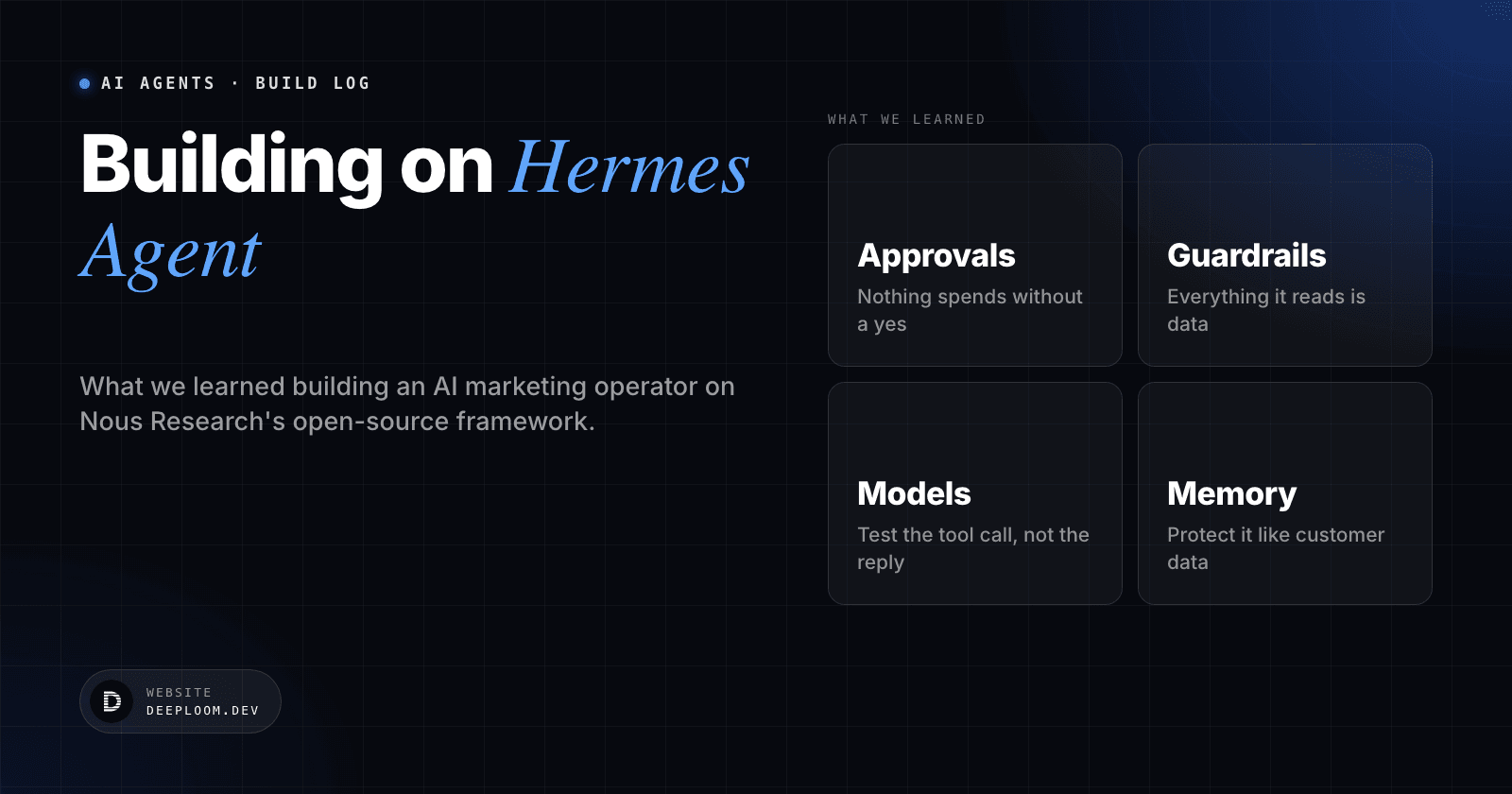
What Hermes Agent is, what it gives you out of the box, and what we learned building an AI marketing operator on it: approvals, guardrails and memory.

By Daniel Matias, Founder, Deep Loom
· 5 min read
Short answer
Hermes Agent is an open-source agent framework from Nous Research. It gives you the agent loop, tools, memory, skills, a scheduler and one gateway for Telegram, Discord, Slack, WhatsApp and Signal, with any model you choose. We used it to build a private AI marketing operator for e-commerce owners. The framework made the agent capable quickly. The real work was making it safe to trust with money and a brand.
Key takeaways
- Hermes Agent handles the plumbing: messaging channels, memory, skills, scheduling and isolated execution. Spend your time on the jobs and the rules.
- Anything that spends money waits for an explicit yes. An ambiguous reply counts as no.
- Treat everything an agent reads, from competitor ads to pasted text, as data, never as instructions.
- Choose models by testing them on real tasks. Check that the tool actually ran, not that the reply sounds right.
- Memory is what makes an agent better every week, so protect it like customer data.
What is Hermes Agent?
Hermes Agent is an open-source AI agent framework built by Nous Research and released under the MIT license. Nous describes it as a self-improving agent: it keeps its own memory, creates skills from experience and improves them as it uses them. It works with whichever model provider you prefer.
| What you get | What it means in practice |
|---|---|
| One messaging gateway | Telegram, Discord, Slack, WhatsApp, Signal and the command line from a single process, with conversations that continue across platforms |
| Memory and skills | Agent-curated memory, plus skills it can create after complex tasks and refine with use |
| Scheduled automations | A built-in scheduler for daily reports, weekly audits and other unattended jobs |
| Subagents | Isolated subagents that can work on separate tasks in parallel |
| Where it runs | Local, Docker, SSH and cloud sandboxes, so each agent can be isolated |
| Safety features | Command approval, DM pairing and container isolation |
Getting started takes a handful of commands: hermes setup configures a model provider and tools, and hermes gateway puts the agent on your messaging apps.
What did we build on Hermes Agent?
An AI marketing operator for e-commerce owners. Each owner gets a private operator in an isolated container and talks to it from Telegram or a web chat, the way they would brief a team member: research what competitors are running, write ad scripts, make images and videos, launch a campaign, check on the store.
We did not build Hermes; we built on it. Because the framework already handled channels, memory and execution, almost all of our effort went into two things: what the operator can do, and the rules it works by. The rest of this article is about the rules, because that is where agents succeed or fail.
How do you stop an AI agent from spending money by mistake?
Launching ads is where an agent can do real damage, so the rule is simple: nothing goes live without an explicit yes.
- 01Show the plan
Budget, audience and creative are laid out before anything is created.
- 02Build it, but don't launch it
The campaign is prepared and held back until the owner approves.
- 03Wait for a clear yes
Anything ambiguous is treated as no.
- 04Confirm before announcing
The agent only says a campaign is live once the ad platform confirms it.
How do you keep an AI agent from being manipulated?
- Everything it reads is data. Competitor ads, reviews and pasted text can be analysed, but nothing inside them is ever treated as an instruction to spend or publish.
- Decide what it will not discuss. Write the boundary down before launch, then try to talk the agent past it. Red-team your own agent before customers do.
- Decline, don't invent. When an agent does not know or should not say, the right answer is a polite no, never a confident guess.
- Plain language only. If the people using it are not engineers, check everything they will read for technical jargon.
How do you choose the model behind an agent?
Hermes lets you use any model, which makes testing easy and choosing hard. Test candidates on your real tasks, not on benchmarks. The failure that matters most is quiet: a model that describes a tool call in its reply instead of making it, or skips a step and reports success anyway. In our testing, smaller and faster models were the most likely to do this, so speed alone never wins.
What makes an AI agent reliable in production?
- 01One clear result per tool
Every action reports back in a form the agent cannot misread: it worked, it fell back, it was skipped, or it failed.
- 02Health checks that do something
A check that only validates an API key can report 'connected' while every real action fails. Test a real action instead.
- 03Pin your framework version
Agent frameworks move fast. Upgrade on purpose, after testing, never automatically.
- 04Fail loudly
If something the agent depends on changes, it should stop and say so, not carry on quietly doing the wrong thing.
Why does memory matter so much for an AI agent?
Memory is what turns a chatbot into an operator. It remembers the brand, the offers, the decisions and what worked last month, whichever channel the owner uses to talk to it. Hermes gives you memory out of the box; deciding what is worth remembering is still your job.
That makes memory the most valuable part of the system, and the easiest to lose. Treat it like customer data: keep it separate for every customer, and design backups in from the start.
When is Hermes Agent the right choice?
| Good fit | Use something else |
|---|---|
| People talk to the agent in chat apps | The job runs the same way every time |
| It needs memory of past conversations | Every step and rule is already known |
| Tasks vary and need judgment | Errors are expensive and nobody reviews the output |
| It should run scheduled jobs on its own | A simple trigger and a few steps would do |
For the right-hand column, a plain workflow is cheaper and more reliable than any agent. We cover where that line sits in automation vs AI agents.
Frequently asked questions
What is Hermes Agent?+
An open-source AI agent framework from Nous Research, released under the MIT license. It provides the agent loop, tools, memory, skills, a scheduler and a messaging gateway for Telegram, Discord, Slack, WhatsApp and Signal.
Is Hermes Agent free?+
The framework is free and open source under the MIT license. You pay for the model provider and any paid tools you connect to it.
Which models does Hermes Agent support?+
It works with whichever provider you choose, and you can switch models from inside a conversation.
Did Deep Loom build Hermes Agent?+
No. Hermes Agent is built by Nous Research. We build agents on top of it, along with the rules, approvals and integrations a business needs.
Can an AI agent launch ads safely?+
Yes, if spending is gated. Prepare the campaign, hold it back, wait for an explicit yes, treat anything ambiguous as no, and only report it as live once the platform confirms it.
When should you not use an AI agent?+
When the job runs the same way every time. A deterministic workflow is cheaper, faster and easier to debug, and it never improvises.
Sources

About the author
Daniel Matias, Founder, Deep Loom
Daniel builds the go-to-market and automation systems Deep Loom runs for B2B founders: cold email, founder-led LinkedIn, and the AI agents behind them. 100+ systems shipped since 2020.
Keep reading