How We Write LinkedIn Content That Books Calls
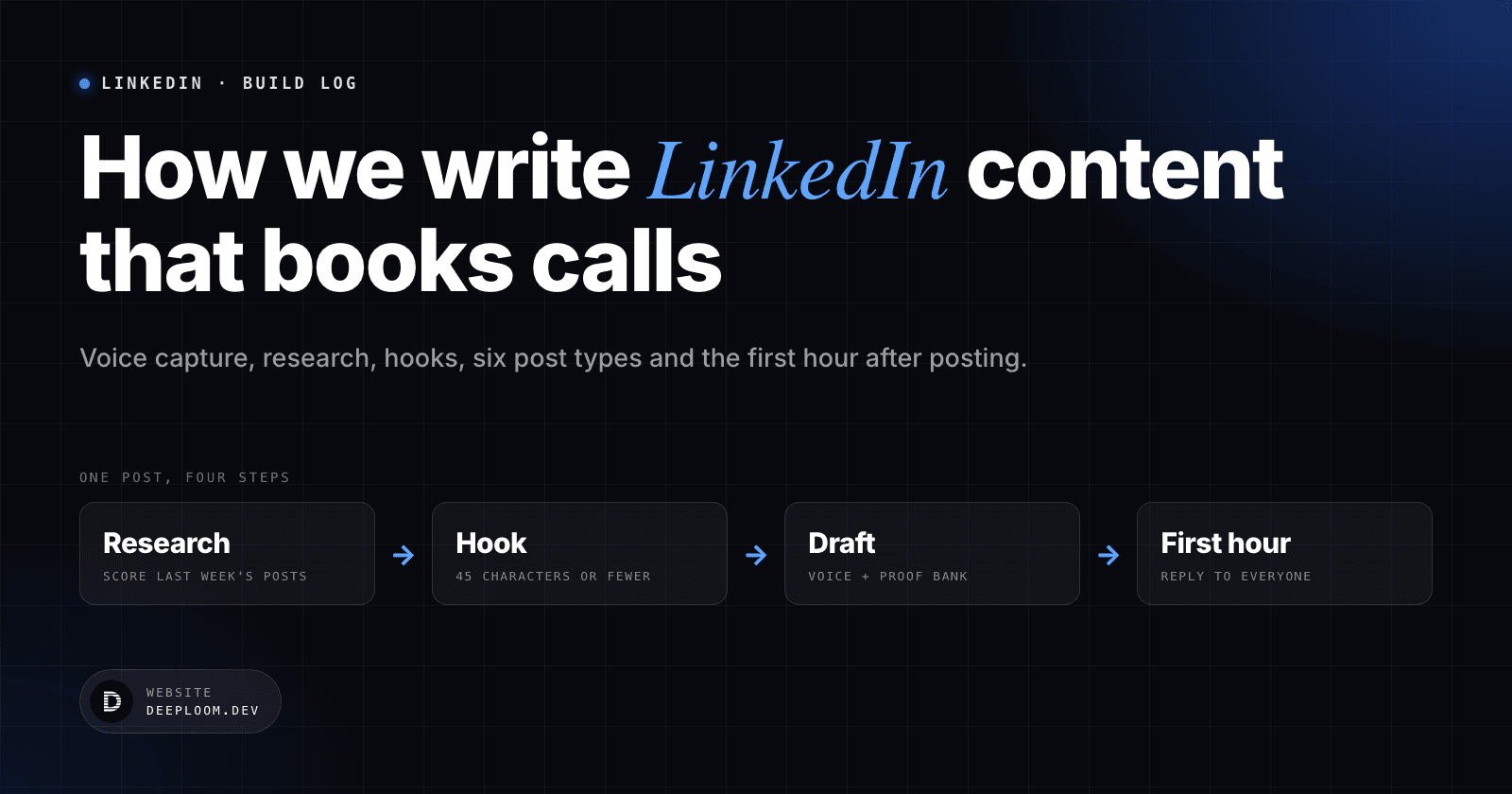
The system behind our founder-led LinkedIn posts: voice capture, research, hooks, six post types, the tool we write in, and the first hour after posting.

By Daniel Matias, Founder, Deep Loom
· Updated · 7 min read
Short answer
We write LinkedIn posts as a system, not one at a time. We research posts that are already working, keep the structure that earned the engagement, and rewrite them in the founder's voice using a written style guide and a bank of real, traceable numbers. Every post has a job in the funnel, and every comment gets a reply in the first hour.
Key takeaways
- Every post has one job in the funnel: build awareness, build trust, or convert. Six post types cover all three.
- Voice comes from inputs, not prompts: a style guide, a proof bank of real numbers, and the founder's own best posts.
- The first line decides the post. Ours stay under 66 characters, with a second line that earns the 'see more' click.
- The ask goes in the first comment, not the post body.
- Measure calls booked and hand-raises, not impressions.
Why do most founder posts get likes but no calls?
Most founders post without giving each post a job. A feed of stories builds awareness but never asks for anything. A feed of offers gets scrolled past. Calls come from a mix, where each post moves the reader one step closer to a conversation.
We use six post types, and each one maps to a stage of the funnel:
| Post type | Funnel job | Length | How it ends |
|---|---|---|---|
| Personal story | Awareness | 180 to 280 words | Scene, turn, lesson |
| Hot take | Awareness to trust | 150 to 230 words | Leaves the question open |
| Tips | Trust | 120 to 200 words | No call to action |
| Explanation | Trust | 180 to 280 words | Belief, mechanism, reframe |
| Case study | Trust to conversion | 200 to 300 words | Results, then an invitation |
| Lead magnet | Conversion | 180 to 260 words | A named resource, ask in the first comment |
We post 3 to 5 times a week, mostly Tuesday to Thursday in the early morning, at lunch or in the early evening. Two lead magnets or two hot takes never run back to back, and at least one story goes out every week.
How do you capture a founder's voice?
Voice comes from inputs, not from a clever prompt. Before we write anything, we collect:
- Positioning and ideal customer, in the founder's own words, including how customers describe their problems on sales calls.
- A proof bank: real numbers with a source we can trace. If a number cannot be traced, it does not go in a post.
- Five profiles they admire, used to calibrate tone, never to copy.
- A style guide: sentence length, how they open and close, and the words they never use.
- Their best past posts, fed back in as examples every time we draft.
That last input compounds. In our tool, each new draft pulls the author's three most recent saved posts of the same type, plus two of other types, as examples. The more posts the founder approves, the closer every new draft sounds to them.
Where do LinkedIn post ideas come from?
We start from what is already working this week, not from a blank page.
- 01Track the right accounts
At least six profiles and six keywords per client: the people and topics the audience already reads.
- 02Pull last week's posts
The tool collects up to 100 recent posts from those profiles and up to 50 from keyword searches.
- 03Score by weighted engagement
Likes, plus comments times four, plus reposts times three. Anything under 60 is dropped, because comments and reposts show a post started a conversation.
- 04Rank on craft, not topic
An AI model ranks the top 20 on hook strength and depth. A strong post about the wrong subject still teaches structure.
How do you write a hook that earns the 'see more' click?
On mobile, only the first couple of lines show before 'see more'. Those lines decide whether the rest of the post exists for the reader.
- Line one stays under 66 characters, and we aim for 45. One breath, one promise.
- Line two re-hooks: it raises the stakes of line one so the click feels necessary.
- Three or four short lines before the body, never a wall of text.
| Hook style | What it does | Pattern |
|---|---|---|
| Curiosity | Opens a gap the reader wants closed | [N]% of [audience] are doing [X] wrong |
| Pain or aspiration | Names a feeling they already have | Never [pain] again |
| Contrarian | Breaks an assumption | Stop [common advice] |
| Authority | Leads with proof | I [result] in [time] |
What does the writing tool look like?
We write inside Evrest, a tool we built for this workflow. Writing a post takes five screens:
- 01Content Feed
Press Research Now and the feed fills with last week's best posts from tracked profiles and keywords. Each is tagged High, Medium or Low with the AI's reasoning, and one click on Write Like This sends it to the Ghostwriter.
- 02Idea Bank
Hooks and posts worth keeping, saved for later.
- 03Ghostwriter
Pick one of the six post types and an idea. The tool suggests five ideas from the founder's knowledge base. The draft appears in a LinkedIn-style preview with the founder's real name and photo, and can be refined with a plain-language instruction.
- 04Post Library
Every post is tracked as Draft, Ready or Posted, with one-click edits: shorten, punch up the hook, add or remove the call to action.
- 05Knowledge Base and Style Guide
The inputs from the voice section live here, and every draft reads them.
Drafts are written by Claude Sonnet 5. A faster model, Claude Haiku 4.5, generates ideas, and Perplexity handles live research for longer lead magnet guides. A person edits and approves every post before it is published.
Why does the call to action go in the first comment?
In our experience, posts that stack a call to action into the body (connect with me, comment the keyword, I will send it over) tend to get less reach. So the body stays clean and the ask lives in the first comment, posted straight away.
The same thinking rules out hashtags and engagement-bait closers like 'What do you think?'. Reach comes from the first two lines and the conversation in the comments, not from tags.
What happens in the first hour after posting?
- 01Minute 0 to 5
Post the first comment, with the ask or extra context.
- 02The first hour
Add two to four more comments, 10 to 15 minutes apart, and reply to everyone who comments.
- 03Lead magnet requests
Reply to each request, send the resource by direct message, and follow up once a day or two later if there is no answer.
- 04Every day
10 to 20 likes and 5 to 10 real comments on other posts in the niche.
What should you measure instead of impressions?
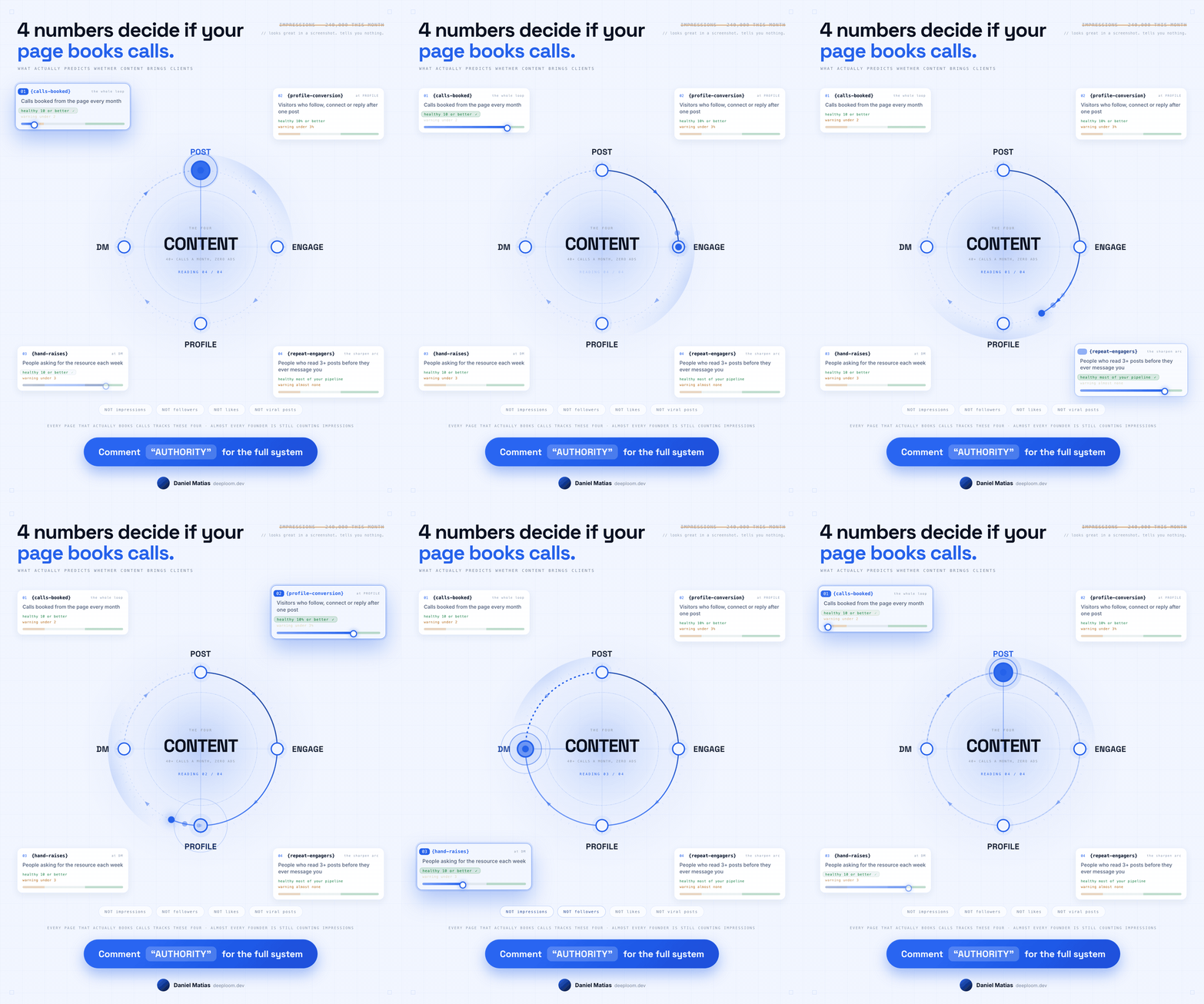
Impressions look good in a screenshot and tell you almost nothing about pipeline. We track four numbers instead:
| Metric | What it counts | Healthy | Warning |
|---|---|---|---|
| Calls booked | Calls booked from the page each month | 10 or more | Under 3 |
| Profile conversion | Visitors who follow, connect or reply after one post | 10% or more | Under 3% |
| Hand-raises | People asking for a resource each week | 10 or more | Under 3 |
| Repeat engagers | People who read 3+ posts before messaging | Most of your pipeline | Almost none |
What results has this produced?
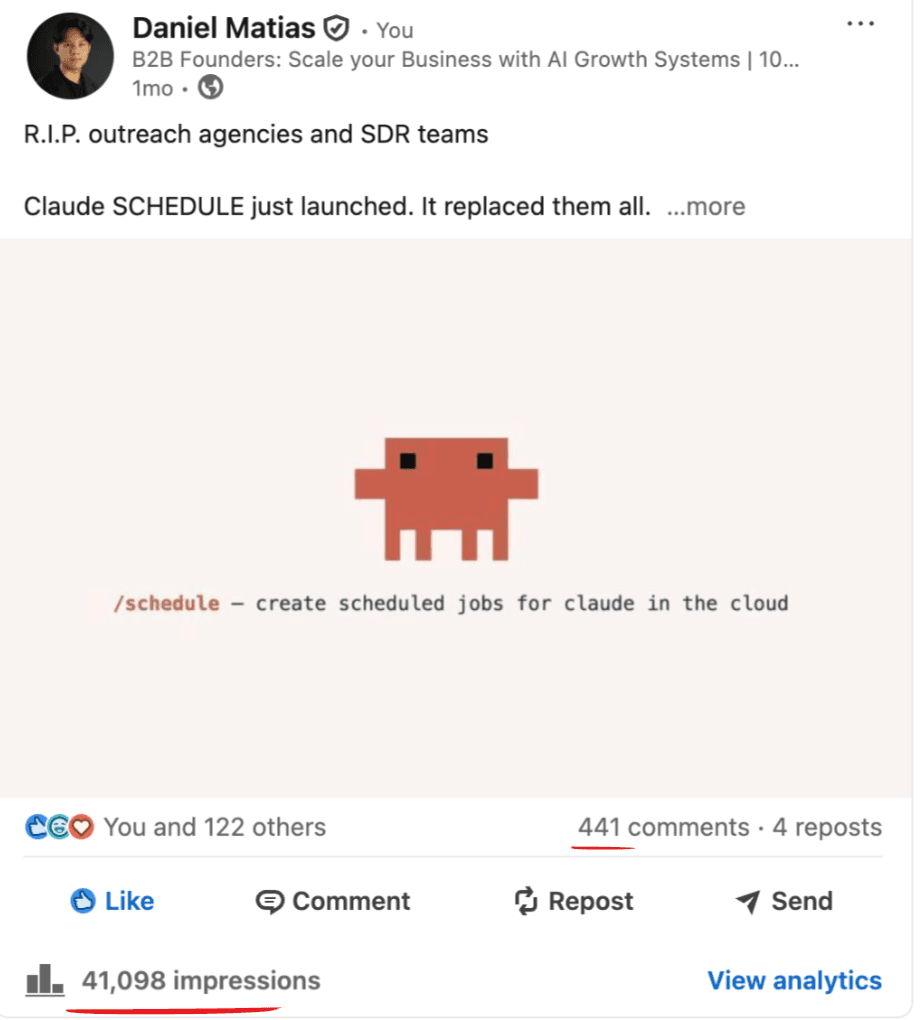
The full breakdown, with each client's numbers, is in our LinkedIn inbound case study.
Content does the most when it runs next to outbound. AI founder and YouTuber Ty Chen paired a LinkedIn content strategy with a signal-based system, and his agency booked 10 qualified calls in its best week. His story and video testimonial are in Ty Chen's case study.
Frequently asked questions
How often should a founder post on LinkedIn?+
Three to five times a week. We post Tuesday to Thursday in the early morning, at lunch or in the early evening, and never run two lead magnets or two hot takes back to back.
How long should a LinkedIn post be?+
Between 120 and 300 words, depending on the type. Tips run shortest at 120 to 200 words; case studies run longest at 200 to 300.
Can AI write LinkedIn posts in your own voice?+
Yes, with the right inputs: a style guide, real past posts as examples, and a bank of traceable numbers. AI writes the draft; a person edits and approves every post.
Should you put a call to action in a LinkedIn post?+
Put the ask in the first comment instead. A clean post body reads better, and in our experience a call to action stacked in the body can limit reach.
Do hashtags help on LinkedIn?+
We do not use them. Reach comes from the first two lines and the replies in the first hour, not from tags.
How long until LinkedIn content books calls?+
It varies. One agency founder closed $136K in the first three months; another client booked 6 calls within 24 hours of a single post.

About the author
Daniel Matias, Founder, Deep Loom
Daniel builds the go-to-market and automation systems Deep Loom runs for B2B founders: cold email, founder-led LinkedIn, and the AI agents behind them. 100+ systems shipped since 2020.
Keep reading