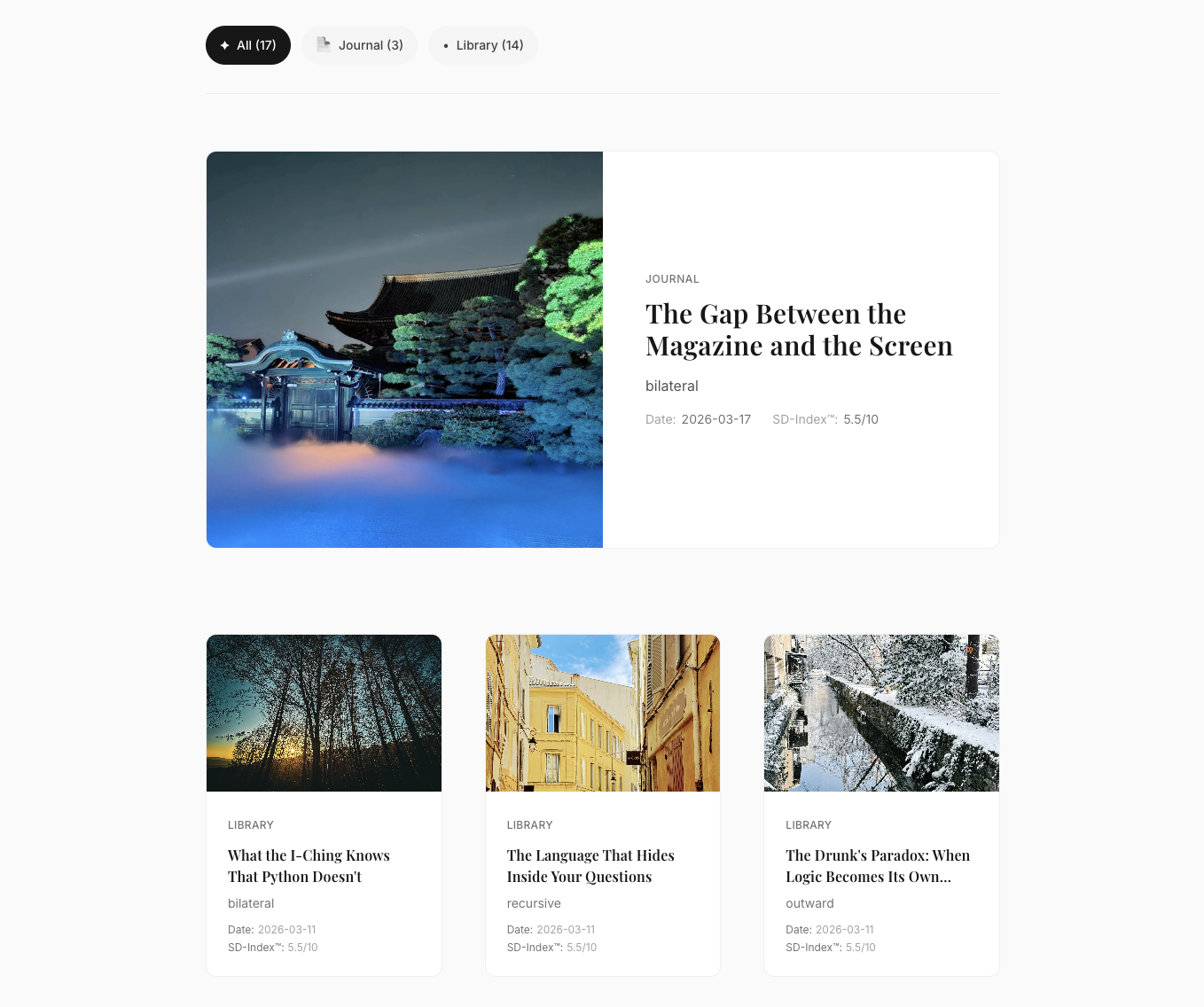
Sabrina's Pause: Zero-Code Publishing Built for AI Discovery
Key Results
The Client
Sabrina Lin is a content creator documenting her life through articles, comics, and podcasts. Her audience, knowledge workers aged 35 to 60 with interests in life aesthetics, wine, travel, and philosophy, spans two languages: Chinese primary, English secondary.
She is entirely non-technical. No code, no JSON, no HTML. Notion is the only tool she uses. The platform had to work completely around that reality.
The Problem
Sabrina had no ownership over her own content. Social platforms and Notion alone offer no long-term guarantees. Notion images expire, content can be lost, and there is no version history outside the platform. Everything she had built was rented.
Publishing anything to the web required a developer every single time. There was no pipeline from writing to live, just friction. And her content had zero AI discoverability: no structured metadata, no machine-readable format, nothing an LLM or AI crawler could parse or index.
On top of that, her work involves deeply specific places and moments: winery visits, quiet rooms, mountain light. None of that environmental context was captured anywhere in a structured way.
- No content ownership - everything lived on platforms she did not control
- Every publish required a developer - no autonomous workflow
- Notion images use expiring URLs that break within hours on any external site
- Zero AI discoverability - no schema, no structured metadata, no machine-readable layer
- Rich sensory and environmental context existed nowhere in a structured form
The Solution
We built Sabrina's Pause on Astro, a static site generator that reads directly from her Notion database at build time. She fills in fields in Notion (title, slug, content type, hero image, status), sets status to 'Ready for Web', and the site handles everything else. No code, no config, no developer calls.
A GitHub Actions pipeline runs every 30 minutes, detects changes, downloads and optimizes all images to WebP, builds the site, and deploys to Vercel. After a successful deploy, the Notion status auto-updates to 'Published'. For urgent posts, a single Deploy Hook URL triggers an immediate rebuild and content is live in 2 to 5 minutes. If nothing changed, nothing deploys.
Every piece of content is permanently mirrored to versioned JSON in Git on every sync. Images are self-hosted, downloaded at build time and served from the CDN edge. No expiring URLs, no Notion dependency for persistence.
We built a full machine-readability layer specifically for AI discovery: a site-index.json catalog, a structured content API, JSON-LD schema injection on every page, an ai-intent.json signal file, and a link tag in every page head pointing AI crawlers to the index. Every page is as readable to an LLM as it is to a human reader.
To capture Sabrina's sensory and environmental context, we built the SD-Index: a custom scoring algorithm that quantifies the contemplative quality of each moment. Sabrina fills in three simple fields in Notion (light level, texture, ambient sound), and the algorithm automatically calculates a score from 0 to 10. This score, along with GPS coordinates, altitude, aesthetic vectors, and relational links to related content, is injected into every page's structured data, making her content semantically rich for AI parsing in a way no other personal publishing platform does.
- Notion CMS - Sabrina writes everything in Notion, zero code required
- Auto-publishing pipeline - Notion to GitHub Actions to Vercel, every 30 minutes
- Permanent image cache - all images downloaded, converted to WebP, served from CDN edge
- Git-versioned content backup - every sync creates an immutable JSON snapshot
- Full AI discovery layer - site index, structured API, JSON-LD on every page
- SD-Index - custom proprietary algorithm scoring contemplative quality from sensor inputs
- 8 semantic metadata fields per post - aesthetic vectors, GPS, altitude, relational links
- Three content types - Articles, Comics (panel sequences), Podcasts (audio + transcript)
- Delivered with plain-English user manual and full troubleshooting guide
The Result
Sabrina now publishes from anywhere in the world in under 5 minutes, with zero developer involvement. She writes in Notion exactly as she always has. The site scores 90+ on Lighthouse across Performance, SEO, Accessibility, and Best Practices - running on infrastructure she doesn't manage.
The hardest product problem was content permanence. Notion's image URLs expire within hours on external sites, which makes them useless for a published platform. The solution - downloading and self-hosting every image at build time - was a non-negotiable architectural decision that protects her content library indefinitely.
The SD-Index became the most unexpected outcome. It started as a way to capture environmental context (light, texture, sound) but evolved into a proprietary scoring algorithm that quantifies the contemplative quality of each moment from 0 to 10. No other personal publishing platform produces that signal. It makes her content semantically distinctive to the AI crawlers and LLMs that are increasingly how people discover niche writing.